
Repercussion Section: Wilder Fires
by Sandra Steingraber, SEHN senior scientist and writer in residence
According to a federal criminal complaint, one year ago, on January 1, 2025, 29-year-old Jonathan Rinderknecht started a blaze on a hiking trail in the Santa Monica Mountains. Six days later, it turned into one of the two infernos that laid waste to vast swaths of Los Angeles. The so-called Palisades Fire.
While reading about his arrest and indictment, I became confused by the word wildfire.
Is a wildfire wild because it starts in a wild, uncultivated place? Or is a wildfire wild because it burns in wild, uncontrollable ways? Is it the fuel that is wild or is it the behavior of the flames?
The history of the word doesn’t really clarify matters. In fact, the first attested use of the word is from the 13th century AD when the Old English wilde fyr was used to refer to a weapon of war, later known as “Greek fire,” whose specific ingredients were a closely guarded secret but likely consisted of some kind of petroleum. As near as I can figure out, wilde fyr was basically napalm that could be blasted at one’s enemy using some sort of flame-thrower situation.
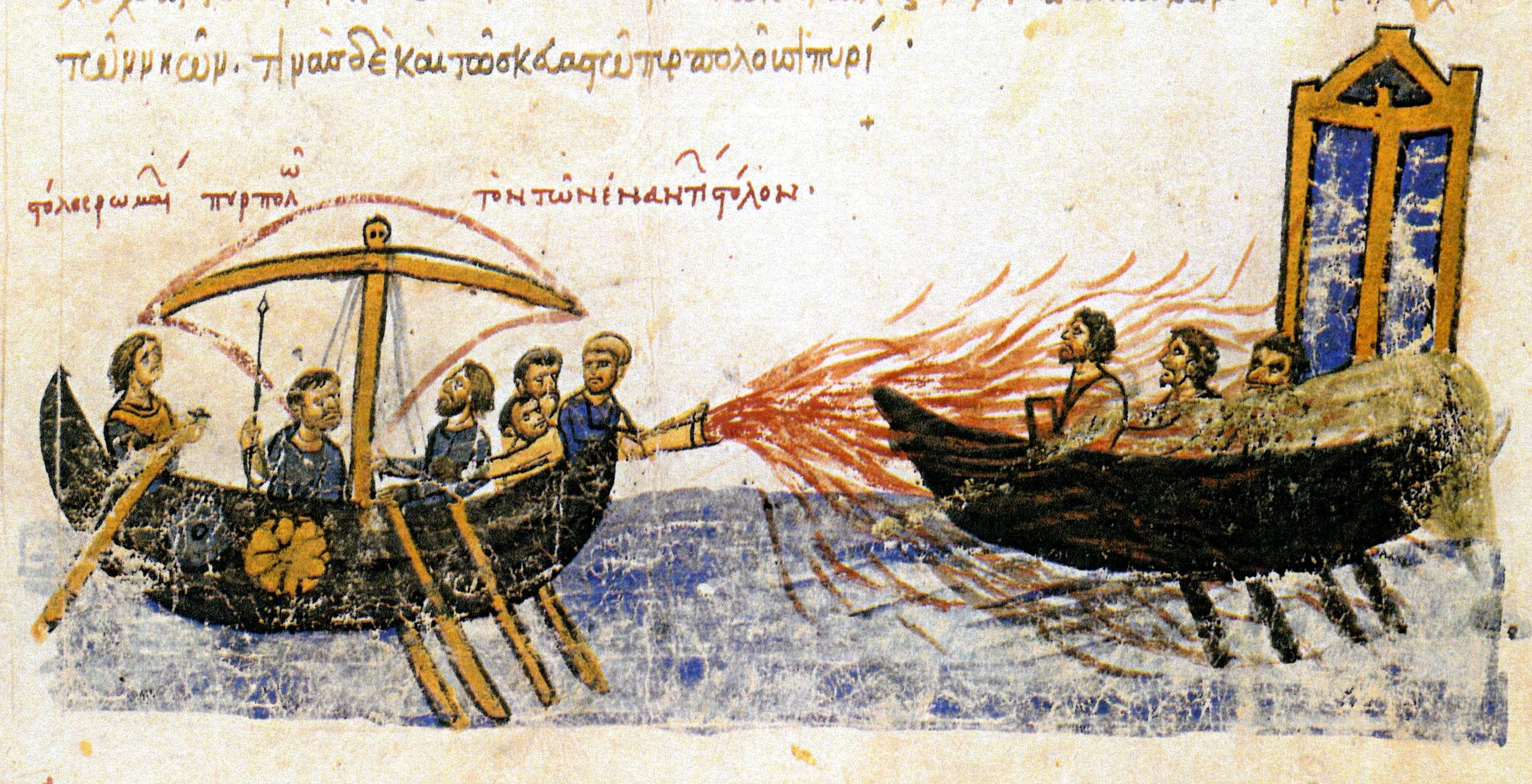
Wylde fyr was the old English term for “Greek fire,” a primitive form of napalm used in warfare.
By Unknown author - Codex Skylitzes Matritensis, Bibliteca Nacional de Madrid, Vitr. 26-2, Bild-Nr. 77, f 34 v. b. (taken from Pászthory, p. 31), Public Domain, https://commons.wikimedia.org/w/index.php?curid=302463
So, the original wildfire involved the ignition of fossil fuels, which is exactly the opposite of how the public health community uses the word now in our attempt to delineate the smoke from burning forests from, say, tailpipe-derived smog.
By the late 14th century, wildfire was being used as synonym for fury and retribution (possibly divine and possibly linked to lightning). So, the wild part of the fire was a behavioral quality.
But that metaphorical usage followed another very literal usage in medicine. In the 13th century, wildfire was not just a type of artillery but also a diagnosis. Wildfire referred to a rash that we now call erysipelas. If you had a bad case of wildfire, it was caused by a streptococcus bacterium.
The word itself then ran away uncontrollably, as many different contagious diseases are now said to spread like wildfire. Measles is one.
But the simple answer I was looking for is in the first definition in the Merriam-Webster dictionary. A wildfire is “a sweeping and destructive conflagration especially in a wilderness or a rural area.” So, in contemporary terms, the essence of a fire’s wildness is in its behavior. Extra credit if a wildfire burns down a wild place.
***
For environmental scientists, wildfires are a phenomenon requiring three elements—fuel, oxygen, and ignition—all of which the climate crisis is providing in ever-greater abundance.
Climate change is increasing drought and thus creating more fuel. Climate change is increasing wind and thus adding more oxygen. And climate change is increasing heat waves and lightning strikes, thus creating more ignition sources.
Ask an environmental scientist about wildfires and they will tell you about burning grasslands and trees. The smoke from these fires, according to a 2025 study, currently kills 99,000 people each year around the globe and contributes significantly to cardiovascular and respiratory diseases. Another study puts the global death toll from wildfire smoke at 330,000 people per year. A third study estimates that the U.S. death toll alone could rise to 71,420 by the year 2050.
Either way, compared to fossil fuel-derived air pollution, which kills 10.2 million people every year and thus contributes to, yes, 1 in 5 deaths worldwide, wildfire smoke might seem like a trivial problem. (As if 99,000-330,000 dead people could ever be trivial.) But that’s because you are underestimating the racing power, fury, and frequency of wildfires.
Three points. First, we are staring at the beginning of an accelerating, self-perpetuating trend. Climate change is fueling wildfires, but the carbon dioxide and methane created in the flames is, in turn, fueling the climate crisis. As the New England Journal of Medicine notes, “Without immediate actions to limit the global temperature increase, the interplay between wildfires and climate change is likely to form a reinforcing feedback loop, making wildfires and their health consequences increasingly severe.”
In other words, the death toll from wildfire smoke is on course to spiral upwards. One recent study estimates that, by 2050, exposure to wildfire smoke could kill 71,420 people in the United States alone. If so, that represents a 73 percent increase relative to the estimated 2011–2020 average annual excess deaths from wildfire smoke. Cumulative excess deaths among Americans, say the authors, could reach 1.9 million between 2026 and 2055. “Our research suggests that the health impacts of climate-driven wildfire smoke could be among the most important and costly consequences of a warming climate in the USA.”
Meanwhile, global projections forecast a surge in the number of premature deaths from wildfire smoke, with 1.40 million people dying annually during 2095–2099, a rate that is roughly six times higher than current levels.
Second, the fine particulate matter from wildfire smoke is smaller in diameter than the particulate matter created by the combustion of many types of fossil fuels and can penetrate deep into the lungs and enter the bloodstream. Hence, wildfire smoke is more harmful than urban smog for those so exposed and is also a known contributor to childhood respiratory disorders—even over great distances. For example, a new study shows that the 2023 Canadian wildfires significantly worsened asthma among children living in Vermont.
Meanwhile, a Stanford University researcher estimates that wildfire smoke is ten times as toxic as the regular air pollution we breathe from the burning of fossil fuels. Compared to urban smog, the smoke from wildfires contains higher levels of both polycyclic aromatic hydrocarbons (PAHs) and volatile organic compounds (VOCs). Both these categories of air pollutants contain carcinogens, notably benzo(a)pyrene, formaldehyde, and benzene.
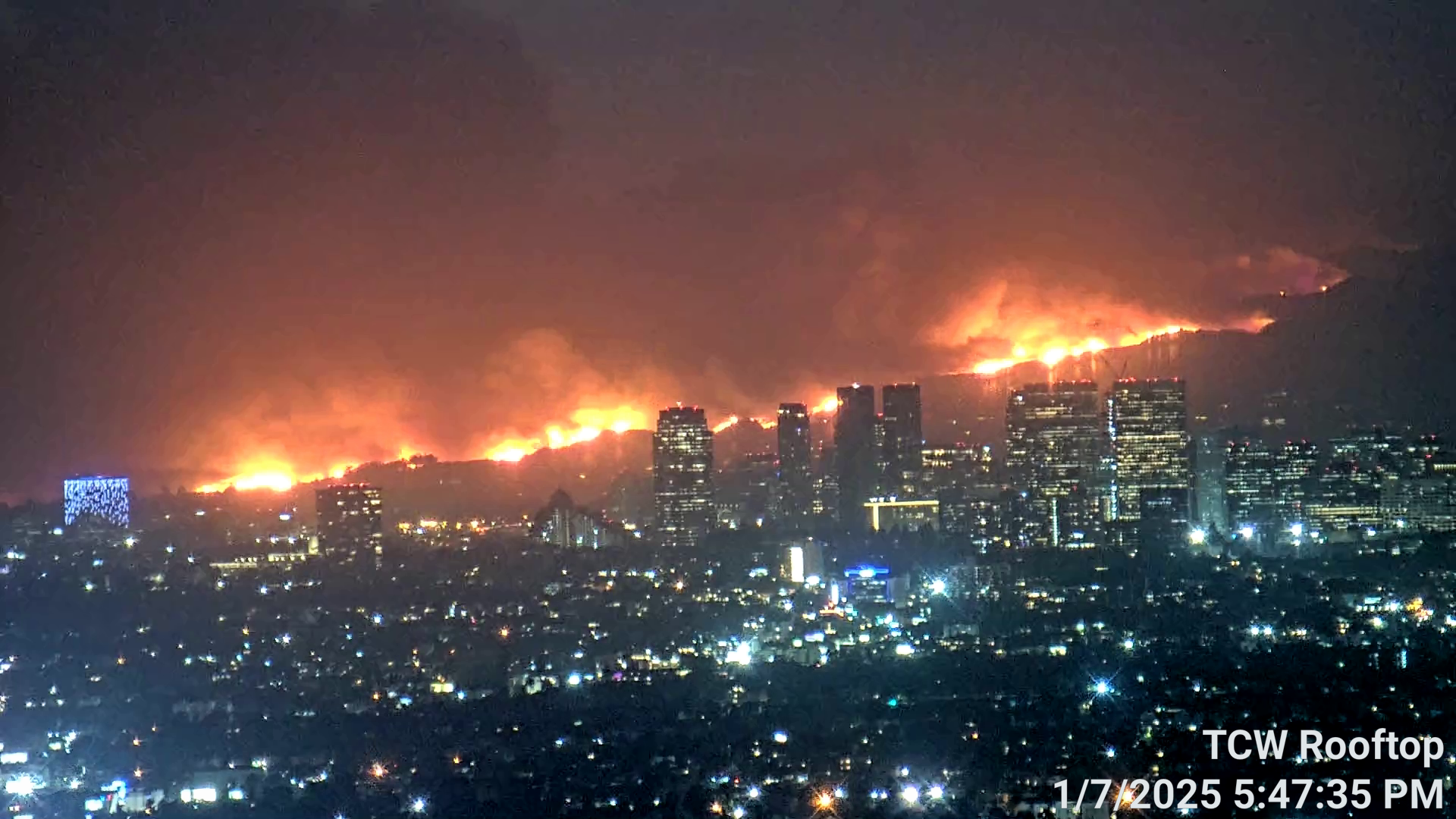
The Palisades Fire began on January 7, 2025 and, for 24 days, swept through Los Angeles, killing 12 people and destroying nearly 7,000 structures.
Toastt21, CC BY-SA 4.0 <https://creativecommons.org/licenses/by-sa/4.0>, via Wikimedia Commons
Third, wildfires do not confine themselves to wild places. As the deepening climate crisis adds more fuel, wind, and ignition sources, wildfires get wilder. They jump streams, crown trees, race up and down mountainsides, and pour themselves into cities where car batteries and vinyl siding become propellants. Urban wildfire smoke contains all the pollutants from wildland wildfire plus additional hazardous substances and is considered even more toxic than rural wildfire smoke.
Consider that the case against Rinderknecht, which goes to trial in April, hinges on the question of whether or not he could have understood what scientists now know: that climate change makes more likely the possibility of “zombie fires.” These are holdover fires that can smolder unseen underground—without a single visible flame on the surface—before roaring back to life days, or even months, after the original fire was presumed extinguished.
Supercharged by climate change, immense wildfires scatter their embers farther where supercharged winds can, like bellows, blow them back to life, even when buried under soil without any visible flames on the surface. The fire lit by Rinderknecht was extinguished by firefighters. It came back to life six days later.
Zombie fires. Who is the arsonist?
***
The Brave Little Parrot is a Buddhist fable about a wildfire. There are many versions of the story, but the one I used to tell my own two kids when they were young—as an explanation for why I was always going to Albany to fight for a statewide fracking ban—went something like this:
There once was a brave little parrot who lived in a forest with many other animals. One day, lightning struck a tree, and it caught on fire. Soon the whole forest was ablaze. Many animals ran away in fear or became trapped with no escape.
But the brave little parrot refused to leave. “This is our only home,” she said.
She began swooping down to the river, scooping up drops of water in her beak, flying through the smoke, and dropping them on the growing flames. She did this again and again. Each beakful of water was no bigger than a thimble.
The gods looked down and laughed. “Little parrot, your beak is too small. You cannot put the wildfire out by yourself. You should run away with the others.”
“I am doing what I can,” replied the parrot. “I do not need your advice. I need your help.”
And the gods were so impressed by her bravery and so ashamed of their own inaction, that they began to cry. The tears of gods extinguished the flames. And the forest was saved.
Shaming the gods through acts of bravery has been my theory of social change ever since.
Much of the research cited in this essay is compiled in the 2021 interactive ebook, Story of Health, which includes a chapter on wildfire smoke. SEHN’s science director, Ted Schettler, MD, MPH, is a co-author. A Story of Health was developed by the Agency of Toxic Substances and Disease Registry, Commonweal, the Office of Environmental Health Hazard Assessment/California EPA, the Science and Environmental Health Network, and the Western States Pediatric Environmental Health Specialty Unit.