
Don't Go Back To Sleep
Friends, we are deeply aware of how unstable things are and how our personal lives are twined with the political, economic, and ecological worlds. And now, on top of the climate crisis and the chemical pollution crisis, which comprise the focus of our daily work at SEHN, our nation is at war with Iran, one of the world’s top producers of oil and natural gas.
We watch as black rain, saturated with oil from bombed oil refineries and storage depots, falls over Tehran, a city of more than 9 million people that is already suffering from an unfixable, climate-fueled water crisis. War is an accelerant to climate change, which itself is an accelerant to water depletion, and it’s clear that the political, economic, and ecological consequences are shredding our fabric of shared destiny even further. And, of course, war also sends missiles into schools full of children.
It all feels like moral injury.
As we talked as a staff about what this issue of the Networker would explore, we decided that our usual contributions—facts and analysis—might add to your overload and sense of injury in this moment.
We know that you are holding up your corner of the world and doing all you can to prevent further damage or unraveling. For many of us, that doesn’t feel like enough. How will we find our way forward in the days ahead?
Perhaps the 13th century Persian poet Rumi has some advice for us as we cope with the injuries inflicted on us and the rest of the world. In his poem “Don’t Go Back to Sleep,” Rumi reminds us to stay vigilant, aware, and oriented toward connection:
The breeze at dawn has secrets to tell you.
Don’t go back to sleep.
You must ask for what you really want.
Don’t go back to sleep.
People are going back and forth across the doorsill
where the two worlds touch.
The door is round and open.
Don’t go back to sleep.
Seven centuries later, Mary Oliver offers a way to stay awake in her poem, “Wild Geese”:
You do not have to be good.
You do not have to walk on your knees
for a hundred miles through the desert repenting.
You only have to let the soft animal of your body
love what it loves.
Tell me about despair, yours, and I will tell you mine.
In the North, we are beginning to see the migrations of birds and small signs of plants responding to longer days. The natural world can be solace for the soul wounds inflicted by wars we cannot stop, neighbors we cannot defend from ICE, and the ravages of climate change on wetlands and forests.
Wendell Berry speaks of that solace in the opening lines of “The Peace of Wild Things”;
When despair for the world grows in me
and I wake in the night at the least sound
in fear of what my life and my children’s lives may be,
I go and lie down where the wood drake
rests in his beauty on the water, and the great heron feeds.
I come into the peace of wild things
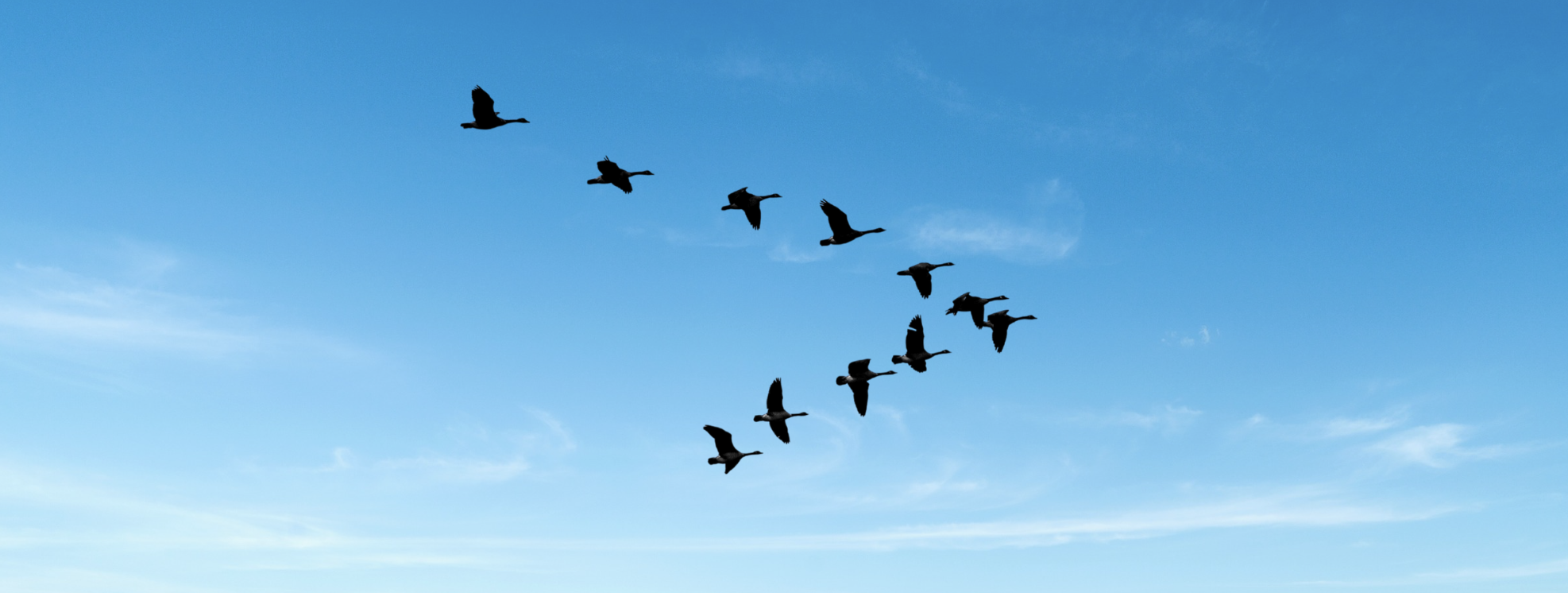
It is Mary Oliver’s geese flying north in their skeins of Vs that offer more comfort by letting us know we aren’t alone: we are in this together with the wild things.
Meanwhile the wild geese, high in the clean blue air,
are heading home again.
Whoever you are, no matter how lonely,
the world offers itself to your imagination,
calls to you like the wild geese, harsh and exciting –
over and over announcing your place
in the family of things.
It is geese who also are an example of how to do this environmental work, how to cope with the moral injuries inflicted by politicians who appear to love nothing, to protect nothing except money and fellow oligarchs. The lead goose heading up the V creates less wind resistance for those flying behind her. They trade off, so one goose doesn’t have to always be the over-worked, tired one. Isn’t that the way in our work too? We take turns facing the headwinds so others can take a rest. We belong. We are all part of the family of things, announced by, of all the wonderful things, geese flying overhead, showing us the way.
Stay awake. Tell your despair. Go through the open and round door into the peace of wild things. We will be stronger for it as you fly with us in the great V.
“You are not meant for crawling, so don’t. You have wings. Learn to use them and fly. ”
Carolyn Raffensperger
Peter Montague
Carmi Orenstein
Ted Schettler
Sherri Seidmon
Sandra Steingraber
P.S. If you doubt that y/our work matters, the story of geese can be solace in many ways. They let us know that sometimes we can pull back from the brink of disaster. In the case of the Canada Goose, they were thought to be extinct in the 1950s but conservation efforts have made the Geese an extraordinary success story and they now number in the millions.
P.P.S. Hear Wendell Berry read his full poem “The Peace of Wild Things.”
Hear Mary Oliver read her full poem “Wild Geese.”