

Repercussion Section: On Nuclear War and Condoms
by Sandra Steingraber, senior scientist and writer in residence
In 1960, the United States was seized by a backyard shelter construction boom stoked by the pre-Internet influencers of the day. Stocked with canned goods and a first-aid kit, a family fallout shelter was promoted as an individual pod of protection against unimaginable planetary devastation that would allow a nuclear family to survive a nuclear war.
In August 1960, the Fraka family of Springfield, Missouri—with their three children, Janet, age 8, Jon, age 6, and Jeff, age 4—spent three days inside a shelter built by local real estate developer Robert K. Manley in a highly publicized event that included invitations to the public to “try the handle on the shelter door and receive information on disaster preparedness.” Promotional materials boasted that a family shelter could easily be repurposed as a photography darkroom or a storage unit in the event that, you know, no bombs fell.
If this all sounds like the analog version of a TikTok challenge designed to generate monetized clicks, it kind of was. By 1961, Manley was adding fallout shelters to the homes that he had built. Outreach to housewives was part of his marketing. Not missing a beat, other companies rushed to offer pre-fabricated shelters that could simply be dropped into a basement or buried in a backyard. The grift was on.

Woman views bomb shelter display stocked with food and other supplies, 1961. Credit: Library of Congress (LC-DIG-ds-07442)
By the end of year, the Federal Trade Commission (FTC) had stepped in and issued rules on the sale of fallout shelters, forbidding businesses to use scare tactics and “horror pictures” to sell their products.
The FTC also warned buyers that, actually, no shelter could offer complete protection against nuclear blasts or fallout. This, in spite of the fact that Federal Civil Defense Administration (FCDA) was openly encouraging home shelter construction along with duck and cover drills in schools.
In other words, one branch of the federal government—the one tasked with consumer protection—warned the citizenry that there was, in fact, no personal solution to the mother of all public health crises that two other branches of the federal government (the Department of Energy and the Department of Defense) were fomenting as part of a proliferating nuclear arms race with the Soviet Union, the unmitigable dangers of which a third federal entity (the FCDA) was downplaying.
By 1962, the family bomb shelter craze had largely waned and many families who had built and installed them had buyer’s remorse.
Looking back more than six decades later, it’s clear that the temporary faith in the family fallout shelter was delusional and harmful to the goal of halting nuclear hostilities. As sociologist Andrew Szasz noted in his 2007 book Shopping Our Way to Safety: How We Changed from Protecting the Environment to Protecting Ourselves, the shelters’ false promise of individual security likely increased the possibility of nuclear war. Not only did their soothing presence make a nuclear conflict seem less unthinkable, their construction—and all the debates about the best architectural design and what kind of stove, bedding, and food they should be provisioned with—distracted attention and media headlines from the urgent task of disarmament. (See Dr. Robert Gould’s essay in this issue of The Networker for that heroic history lesson.)
Sometimes the save-yourself act of seeking an individual solution to a collective problem just makes the problem worse.
***
I am too young to remember the bomb shelter craze of 1960-1962, but I did come of age during the AIDS crisis of the 1980s. And by 1990, I was a brand-new biology professor living in Chicago, often mistaken for a student in the hallways and elevators. Maybe because of my apparent youth—or the fact that I was the sole woman on the faculty in my department—I was assigned to serve as the AIDS Awareness Coordinator for my entire campus.
This involved lots of presentations involving condoms and bananas.
Life-saving drug treatments were still years away and all the specific routes of exposure were not yet elucidated. But it was clear, by 1990, that a virus called HIV was almost certainly the sole, causative agent of AIDS. It was also clear that—along with intravenous drug use and blood transfusions—sex with men carried risk of HIV infection. By 1990, emerging studies had showed that condoms could significantly lessen the risk of contracting HIV, while AIDS itself remained pretty much a death sentence.
And death was everywhere. In February 1990, pop artist Keith Haring died of AIDS at age 31, and legendary fashion designer Halston was dead a few weeks after that. Dancer and choreographer Alvin Ailey had died two months earlier. Freddie Mercury, lead singer of the rock band Queen, would be buried a year later at about the time basketball superstar Magic Johnson announced that he was HIV positive.
Unlike weapons of mass destruction, a condom is a personal choice. It’s a sexual bomb shelter that works to provide protection against a collective problem. And it prevents you from becoming an exposure pathway to someone else.
But condoms, as I quickly learned, exist in a cultural and political space. They need to be affordable—preferably free—and ubiquitously available. And you have to know how to use them. Or convince your partner to. In the dark. While drunk. In the back of a car. With zero accidents.
Condom skill sets are a thing, as the veteran AIDS awareness trainers made clear to me. And it was a thing that I was supposed to teach. First-time users of condoms have significantly higher failure rates.
In this particular political moment, how to use a condom was the most important science lesson I could offer. Which would mean breaking all kinds of cultural taboos for many of my students, especially those from immigrant families.
Silence = Death. Got it.
I would need to find a language for the most personal and intimate of topics and speak in a way that created curiosity, banished shame, overcame denial, and assuaged terror while still making clear that AIDS kills.
I read a lot of virology. I gave a lot of presentations. I put a lot of condoms on bananas. Lines started to form outside my door during office hours.
Students wanted to know where a drug-using family member might find a needle exchange program. They wanted to know where they themselves could get tested anonymously for HIV, and, during the two-week period between testing and results, could they come back and just sit with me as they tried to manage their fears?
Some of the women students who came to my office told me about sexual assaults and abusive partners. Some of the men told me about their first same-sex encounters. Many had questions about anal sex. Some were fuzzy on where babies come from.
We talked about the disruptive protests taking place in Atlanta, where AIDS activists—some of them dying of the disease themselves—were protesting the Centers for Disease Control (CDC) for excluding women’s symptoms from the definition of AIDS.
And we talked about the ACT-UP boycott of an international AIDS conference in San Francisco, which helped force an end to the travel ban on HIV-positive individuals, and the storming of the National Institutes of Health (NIH) offices in Bethesda, Maryland, where activists demanded access to emerging drug therapies and a seat at the table where decisions about clinical trials were being made. People with AIDS wanted more funding for more research. And they insisted on having a voice in directing that funding.
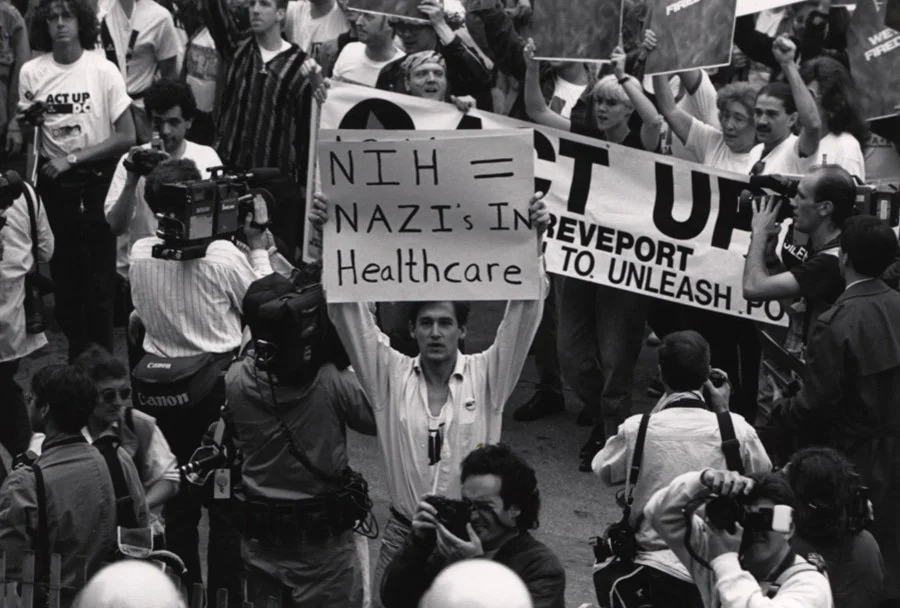
On May 21, 1990, ACT-UP protestors, in an act of civil disobedience, stormed the National Institutes of Health in Bethesda, MD to demand that the NIH accelerate the pace of AIDS research. Credit: NIH History Office
Our office-hour conversations, which extended way beyond condom skills, felt like life-or-death biology. In 1990, the male faculty members in my department felt sorry for me. I did not feel sorry for me.
Sometimes the save-yourself act of seeking an individual solution to a collective problem opens a door to so much else.
***
The Strait of Hormuz is where the specter of nuclear war and issue of condoms co-exist.
In March 2026, a nuclear-armed nation—our own—began bombing Iran under the guise of preventing it from enriching uranium and developing nuclear weapons. This military campaign began less than two months after the Science and Security Board of the Bulletin of Atomic Scientists—founded by Albert Einstein and Robert Oppenheimer in 1945—had moved the needle of the famous Doomsday Clock to 8 seconds to midnight, the closest it has ever been.
Did the United States then go on to insinuatingly threaten Iran with a nuclear attack in April? The White House denied the charge, but the question is openly debated.
What we do know with certainty is that the Strait of Hormuz—that narrow sea passage between Iran and the Arabian Peninsula—promptly shut down, stranding 25 percent of the world’s seaborne oil trade, 20 percent of global LNG exports, and 20 percent of seaborne fertilizer exports. The result has been an immediate and ongoing global energy shock and a looming food crisis.
And also a condom crisis.
The Malaysian company Karex makes 20 percent of the world’s condoms—about 5 billion every years—and has long supplied government-funded AIDS-prevention programs all around the world. Since 1920, most of the world’s condoms have been fashioned from natural latex, which, like maple syrup, is derived from the sap of trees, but Karex and other condom makers also need to source ammonia (used to preserve the latex), silicone oil (used to lubricate the condom), and aluminum (for the foil packaging). And these materials are all shipped through the Strait of Hormuz, along with some of the other 100 or so chemicals used in condom manufacturing.
At the end of April, Karex warned that shortages of raw materials caused by the United States’ war with Iran would disrupt condom production and jack prices by up to 30 percent.
Which is to say, safe sex is about to get more expensive and condoms less ubiquitous at a time when the incidence of sexually transmitted diseases is rising around the world and in the United States.
And at a time when condom distribution programs for AIDS prevention are already reeling from the White House decision to defund the U.S. Agency for International Development, which had played a leadership role in these efforts.
And as traumatizing as my early years as a biology professor in an urban arts college felt at the time—with terrified students staring down the AIDS epidemic before we knew everything about how exactly HIV was transmitted, before condom use was fully normalized, and while dying activists were storming the barricades of the NIH and the CDC to demand more money for more studies to be carried out more quickly—these years seem almost quaint now that these same public health agencies have been gutted.
Among the 10,000 federal scientists who were fired, reassigned, quit, or retired last year were the NIH division chiefs who oversaw research into HIV/AIDS. As of May 2026, eight of the top 10 officials at the National Institute of Allergy and Infectious Diseases had been ousted.
What happens to condom skills when condoms are expensive and in short supply and the condom skills educators have all lost their funding?
Sometimes the save-yourself act of seeking an individual solution to a collective problem relies on a shared belief that a collective problem exists. And on the existence of functioning systems to address it.