

Repercussion Section: Glyphosate: A Short, Unfinished Biography
by Sandra Steingraber, senior scientist and writer in residence
The oil and gas industry has many chemical offspring. One of them is single-use plastics—so-called “frackaging”—which is manufactured from ethane, a waste product of fracking that comes up out of the ground with methane when natural gas is extracted. Another is anhydrous ammonia fertilizer, whose starting point is methane itself. A third is polyester.
And then there is the kid who is out there serving as the subject of a recent Supreme Court decision and making headlines for himself: the weedkiller glyphosate. Otherwise known by the brand name Roundup and sprayed on 90 percent of U.S. corn and soybeans, glyphosate makes industrial agriculture possible.
It is also an avatar for unintended consequences.
Here’s a short, unfinished biography.
***
Glyphosate is a baby boomer, first synthesized in 1950. But, although it belongs to the same chemical generation of toxic, post-war pesticides that biologist Rachel Carson warned us about in 1962, glyphosate does not appear in her book Silent Spring. That’s because it wasn’t marketed to poison plants until 1974.
In its youth, glyphosate was an underachiever. The man who first synthesized it, a Swiss chemist named Henri Martin, wasn’t setting out to help farmers keep weeds out of their fields—or even solve any human problem at all. He was just trying to make bespoke petrochemicals that his company could patent, which would guarantee a monopoly on sales. A search for glyphosate’s possible role in the world came after the fact.
In 1964, the patent landed with the Stauffer Chemical Company in New York, which noted that Martin’s chemical compound had the ability to bind with minerals. Such chemicals are called chelating agents. Possibly then, glyphosate could have a future in preventing metal from leaching from cans into canned foods.
Or, if it could prevent calcium scaling in water pipes, maybe glyphosate had the temperament for a career in boilers.
Along came Monsanto—developer of famously poisonous DDT, PCBs, and Agent Orange—who saw in glyphosate something that previous holders of its patent had noted but overlooked: it was biologically active.
Further research revealed that glyphosate interfered with a particular enzyme (EPSPS) found in plants that is necessary for the manufacture of three amino acids—phenylalanine, tyrosine, and tryptophan—which, in turn, are used to make plant proteins that are necessary for life. Disrupting the EPSPS enzyme by exposure to glyphosate causes plants to die.
On this basis, glyphosate was trademarked and commercialized as a weedkiller in 1974. Because birds and mammals, including humans, don’t have EPSPS enzymes, Monsanto created a whole marketing campaign around the idea that glyphosate could act as an assassin of weeds while remaining a harmless friend to both farmers and the eaters of food grown in fields sprayed with glyphosate.
And, in keeping with its practice of branding its ag chemicals with “Western themes” to give farmers a sense of control (see also Lasso and Ramrod), Monsanto gave its glyphosate-formulated herbicide a cowboy name: Roundup.
A remaining problem, of course, was that the indiscriminate spraying of glyphosate could also kill the crops themselves. This issue was overcome with biotechnology.
Monsanto scientists first genetically modified a plant cell in 1982. Fourteen years later, the first crop made resistant to glyphosate exposure came on the market: the so-called Roundup Ready soybean. Soon after followed Roundup Ready canola, Roundup Ready corn, and in 2006, Roundup Ready cotton. Also sugar beets and wheat.
It was genetic modification that allowed Roundup to become the most widely used herbicide in agriculture, as it allowed spraying of weeds throughout the entire growing season of the crop.
Trends in use became exponential. By 2016, an estimated half a pound of glyphosate-based herbicide had deployed on every cultivated acre of land worldwide.
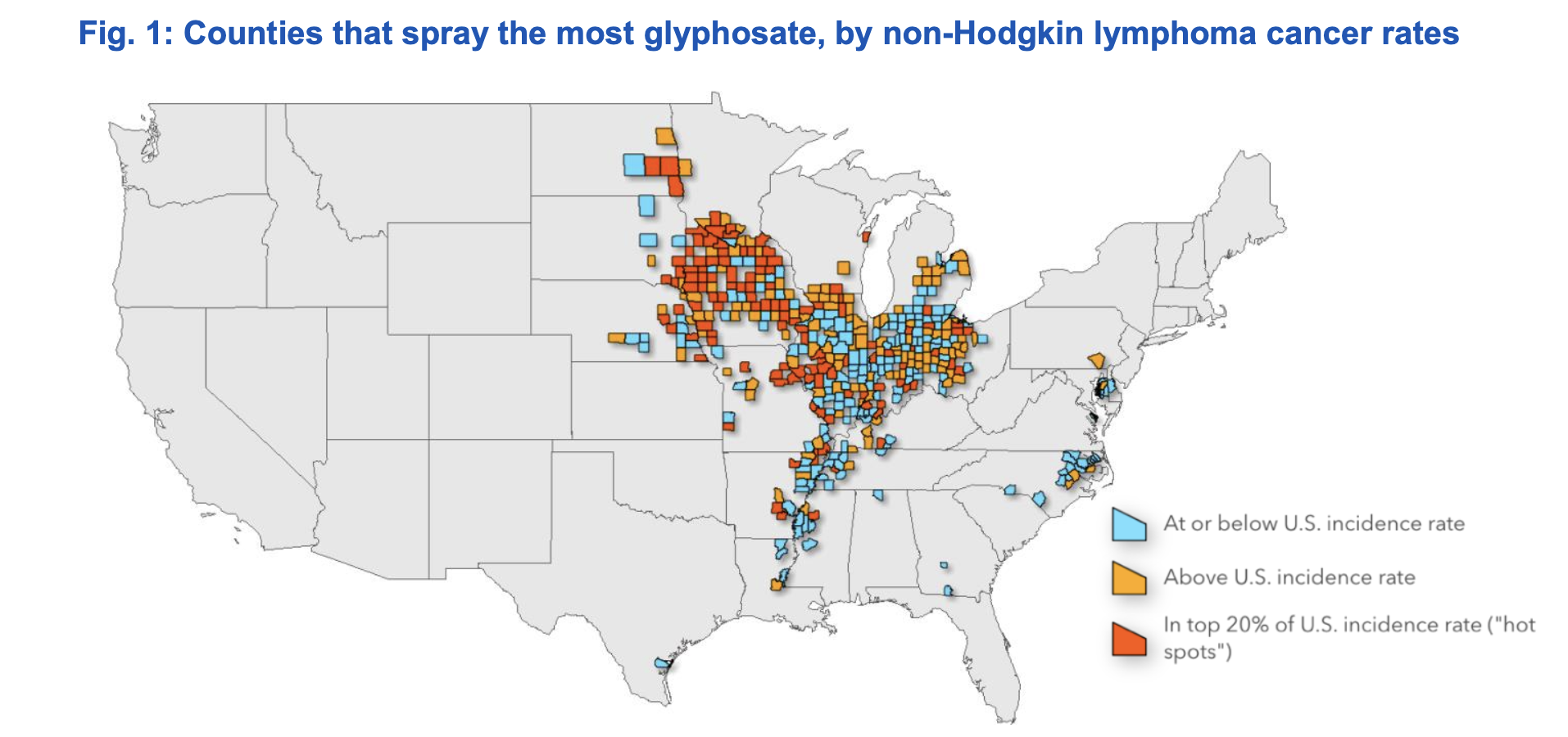
And that is also why, in the three decades since the 1996 debut of Roundup Ready soybeans, glyphosate is now detectable in soil, water, air, food, and in the tissues of 70 to 80 percent of people who have been tested in the developed world, including children.
It’s been found in honey. And lentils. And raisins. And breakfast cereal. And fish.
And at higher levels in the bodies of pregnant women in Idaho living less than one-third of a mile away from glyphosate-treated fields than among pregnant women living farther away.
***
The question of glyphosate’s unintended consequences has been the subject of investigation by independent scientists since it was first introduced in 1974.
One of the earliest researchers was Purdue University plant scientist Don Huber—Korean War veteran and father of eleven—who began to wonder about glyphosate’s original skill: it’s proclivity at chelating metals, some of which, like zinc and manganese, are minerals that play essential roles in plant growth. Without them, crops can become diseased and die.
Huber also turned his attention to the antibacterial and antifungal properties of glyphosate. While the specific enzymatic pathway that glyphosate disrupts in plants is not found in animals, it is found in bacteria and fungus. And bacteria and fungi are star players in the soil’s microbiome and, among other symbiotic roles, help ferry water and oxygen to plant roots.
From an interview he gave in 2025 that looks back on his many decades of research, Huber reflected on the unintended ability of glyphosate to alter the ecology of the entire agricultural system simply by being carried inside the tissues of a plant’s roots. Crops genetically engineered to be resistant to the poisonous effects of glyphosate are, in essence, recruited to serve as a transportation and distribution system for that poison. The roots are the spray nozzle.
And roots full of glyphosate can penetrate far deeper than the surface of the soil on which the herbicide was sprayed:
Glyphosate is highly water-soluble, and it’s highly systemic. It may only move about a half inch in the soil, but it chelates very rapidly in the area it’s exposed to.
The problem, when you put it on a Roundup-ready plant, is that it’s still systemic. It may not kill the plant, but anywhere that root system goes, glyphosate goes. It changes the biology, from the antibiotic effect, and changes the mineral availability — not just for a half inch or an inch, but for 20, 25 feet for alfalfa, for instance.
With glyphosate, you don’t change one thing; you change everything. It’s a chemical that does exactly what it was designed to do, and that’s to kill.
Meanwhile, other researchers asked questions about what glyphosate might be doing to our own microbiome, that secret garden inside of our intestines. Our gut microbiome is teaming with beneficial bacteria that toil away on our behalf. They digest fiber, provide enzymes to make vitamins for us, regulate our cholesterol, train our immune system, tamp down inflammation, and even—via the gut-brain axis—stimulate the production of brain neurotransmitters like serotonin.
Metagenomic studies showed that glyphosate-based herbicides, acting as antibiotics, can damage the gut microbiomes of honeybees and laboratory rats and alter the composition of urinary metabolites. Questions then were raised about possible associations between glyphosate and neurodevelopmental disorders.
Other research, published in 2013, found that, unexpectedly, glyphosate can disrupt mammalian enzymes after all. Specifically, it can suppress a group of liver enzymes that we use for detoxifying other substances. This finding indicated that glyphosate exposure likely “enhances the damaging effects of other food borne chemical residues and environmental toxins.”
From here, questions were raised about possible links to obesity, diabetes, heart disease, and Alzheimer’s.
Also cancer.
In 2015, the International Agency for Research on Cancer within the World Health Organization, as part of a review of more than 1,000 studies, classified glyphosate as “probably carcinogenic” to humans, with the strongest evidence linking it to non-Hodgkin’s lymphoma. This was the declaration that launched a thousand lawsuits.
But in February 2020, the U.S. Environmental Protection Agency departed from these conclusions, declaring in an interim decision that glyphosate posed no significant health risks to humans and likely does not cause cancer, thus paving the way for its continued use.
In that same year, a major paper published in the journal Regulatory Toxicology and Pharmacology titled “Safety Evaluation and Risk Assessment of the Herbicide Roundup and Its Active Ingredient, Glyphosate, for Humans, concluded that “the use of Roundup herbicide does not result in adverse effects on development, reproduction, or endocrine systems in humans and other mammals.”
In 2026, the White House itself weighed in, in a move that enraged the President’s Make America Great Again supporters who had—inexplicably to me—pressed for restricting glyphosate on the grounds that the scientific evidence for harm was indisputable. On February 18, the famously anti-science, anti-regulatory, pro-fossil fuel Donald Trump did the opposite, releasing a signed executive order promoting the use of glyphosate and “ensuring its adequate supply” as a matter of national security.
And in that same month—plot twist!—the journal Regulatory Toxicology and Pharmacology retracted their 2000 paper—25 years after its publication—in response to concerns “regarding the authorship of this paper, validity of the research findings in the context of misrepresentation of the contributions by the authors and the study sponsor and potential conflicts of interest of the authors.”
Translation: emails had surfaced, as part of all those pending lawsuits, that showed the original study had been partially written by Monsanto employees, who all congratulated themselves for the great work.
Finally, in March 2026, a group of public health experts gathered in Seattle for a two-day glyphosate symposium, reviewed all the evidence, and published a statement that summarized the known and suspected human health harms of glyphosate exposure and called for a precautionary approach. The Seattle Glyphosate Symposium reached a conclusion that can only be described as irreconcilable with that of the EPA.
An excerpt:
Glyphosate and glyphosate-based herbicides (GBHs) harm human health and can cause cancer. The comprehensive evidence supports this conclusion, with the strongest epidemiological evidence linking exposure to increased risk of non-Hodgkin lymphoma…
There is additional evidence from human and/or animal studies that glyphosate and GBHs increase the risk of multiple adverse health effects in addition to cancer, including diseases of the kidney and liver, and impacts to the reproductive, endocrine, neurological, and other metabolic systems. Children, infants and fetuses are the most susceptible.
Further strong evidence finds that glyphosate and GBHs cause genetic damage, oxidative stress, and hormonal disruption — biological changes that can set disease in motion. Our understanding of glyphosate’s ability to cause these changes has developed from multiple lines of evidence…
Additional research is needed to better understand the full extent of glyphosate’s and GBH’s effects on human health and the underlying mechanisms involved, such as epigenetic alterations, microbiome disruption and endocrine effects.
The evidence that glyphosate and GBHs harm human health at levels of current use is now so strong that no additional delays in regulation of glyphosate can be justified. Regulatory agencies in countries around the world should treat glyphosate and GBHs as hazardous, as some countries have started to do. Agencies should act without further delay to limit their use, or eliminate them if legally required, to protect public health. These actions should be implemented without delay while research continues.
***
The headlines came on June 25, 2026: “Pesticide Maker Stacks Wins Against US Environmental, Public Health Groups.”
In a 7-2 opinion written by Justice Brett Kavanaugh, the court ruled in Monsanto v Durnell that the Federal Insecticide, Fungicide, and Rodenticide Act preempts state laws and that, hence, Monsanto (now Bayer, which bought up Monsanto in 2018) cannot be sued in state courts for failure to warn consumers about the dangers of glyphosate, which the U.S. EPA has, after all, deemed safe for use.
Thus was a case that had been won by a Missouri gardener and cancer patient, John Durnell, overturned.
Durnell had prevailed in his lawsuit against Monsanto in 2019—the jury awarded him $1.25 million—and a Missouri appeals court had upheld the decision. Until it was reversed by the U.S. Supreme Court in a ruling that is expected to shut down thousands of other lawsuits alleging harm from glyphosate.
***
John Durnell, resident of St. Louis, sprayed Roundup in parks and playgrounds around his historic neighborhood for more than 20 years before his diagnosis with non-Hodgkin’s lymphoma. He called himself “the spray guy.”
Monsanto was founded in St. Louis in 1901. Its first product was saccharin, which it sold to a new company in Georgia called Coca-Cola. Saccharin is one of the oldest children of the oil and gas industry, fashioned from an ingredient found in crude oil called toluene.
On October 16, 2026, our friends at the Collaborative for Health & Environment will host a free webinar that will discuss the recent findings of the Global Glyphosate Study that was the centerpiece of last June’s Seattle Glyphosate Symposium, with a focus on cancer, neurotoxicity, and endocrine disruption. All are welcome.