

Nitrates in our Iowa Water: Practicing Democracy is the Path to Change
by Kamyar Enshayan
The local community—the city, county, and schools—are the fundamental units of decision making and democracy. Sure, state and federal levels of governance are very important as well, but they are often out of reach of ordinary citizens, while local elected officials live in their communities and can be far more accountable. And as it turns out, there are a whole host of decisions affecting every aspect of community life and resilience that are made by local governments. Local citizen involvement can shape those local policies.
Adopting stronger energy conserving building codes, walkable neighborhoods, managing parks and school grounds without pesticides, better public transportation systems, investing in renewable energy, floodplain policies that give more room to the river, improving school meals, access and availability of fresh local foods, fair wage policies, better housing... These are all examples of what some local governments have championed because local residents pushed for them. Neither the federal government or state government are forcing a school district to use pesticides on their lawn, neither state nor federal government are forcing a city to allow builders to build in the floodplain. These are entirely our own doing.
A local problem, such as high nitrate in our local municipal wells, can draw people to better understand a problem they had not previously paid attention to, but also can help them see a much bigger picture of agriculture that keeps bringing them these problems in a state like Iowa.
On Aug 11, 2025 I went to the Cedar River at downtown Cedar Falls, and tested the water for nitrate level. It was between 10-20 milligrams per liter (mg/L), say 15. I looked up the flow of the Cedar at that location on that day: it was 6950 cubic feet per second. So, how much nitrate was going by downtown every hour? 23,383 pounds of fertilizer every hour. That's more than a half million pounds flowing by on that one day.
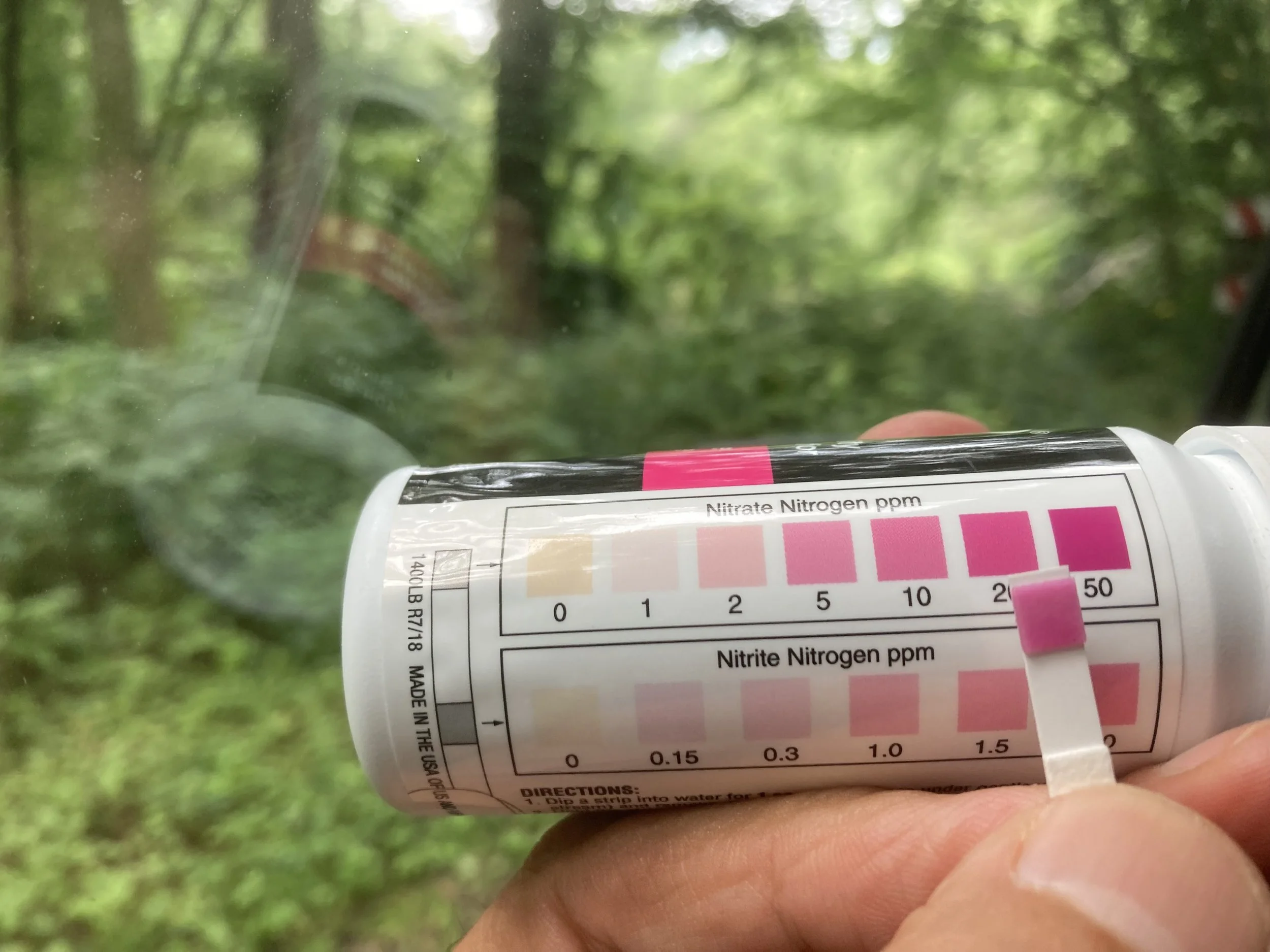
Black Hawk Creek, which pours into the Cedar River in Northeast Iowa, August 12, 2025. Photo by the author.
Surface water does find its way into groundwater and into wells. That is why some 60 communities in Iowa are struggling with rising nitrate levels in their rural and municipal wells. Drinking nitrate in water can lead to a number of health problems. The maximum level of nitrate in drinking water was set at 10 mg/L by the federal government in 1991. We now know that it needs to be much lower than 10. Studies in Iowa and elsewhere have shown that people drinking water with nitrate levels greater than 3 mg/L significantly increase their risk of bladder, thyroid, ovarian, and colorectal cancers. There are also associations with reproductive harms affecting the development of the fetus such as low birth weight, preterm birth, and spina bifida.
How many people in our metro area regularly drink water with nitrate at above 3 mg/L? We do know that some wells are running at close to 10 mg/L and others at zero or 1. So, a small group of us organized a series of gatherings in libraries of towns whose wells have been contaminated with nitrate. We led discussions that helped people see the actual levels of nitrate in their wells and outlined the evidence of increased risks of certain cancers and reproductive harm. We discussed how the current limit of 10 mg/L does not protect our health, and most importantly, these extreme levels of nitrate are not normal, are unnecessary, and are entirely preventable, if certain upstream policies were implemented in our region, supported by state and federal resources.
In Iowa, most local governments continue to tell their residents that their community has great water, that they are compliant with the law, that basically all is well. No mention of the costs imposed on the community by upstream enterprises (too much corn and too much animal waste). No mention of knowledge of health harms from drinking compliant levels of nitrate. So although Iowans have been told for so long that all is well, headlines are announcing that Iowa "ranks second nationally in age-adjusted cancer incidence and is one of only two states where new diagnoses are still rising." All is not well, and people are increasingly asking questions.
Through involvement of many local residents, we recently asked our city to hold a public hearing where our water utility shares with us the state of nitrate in each well, so that we can ask questions, offer ideas, learn who advises them on matters of health, and ask for a community plan to address the tragedy of nitrate contamination of groundwater. Local governments need to clarify and communicate with local residents about the extent of nitrate contamination—but we need to demand it—so that we know the situation we are in, so that we can advocate for clean drinking water at the statehouse and federal levels.
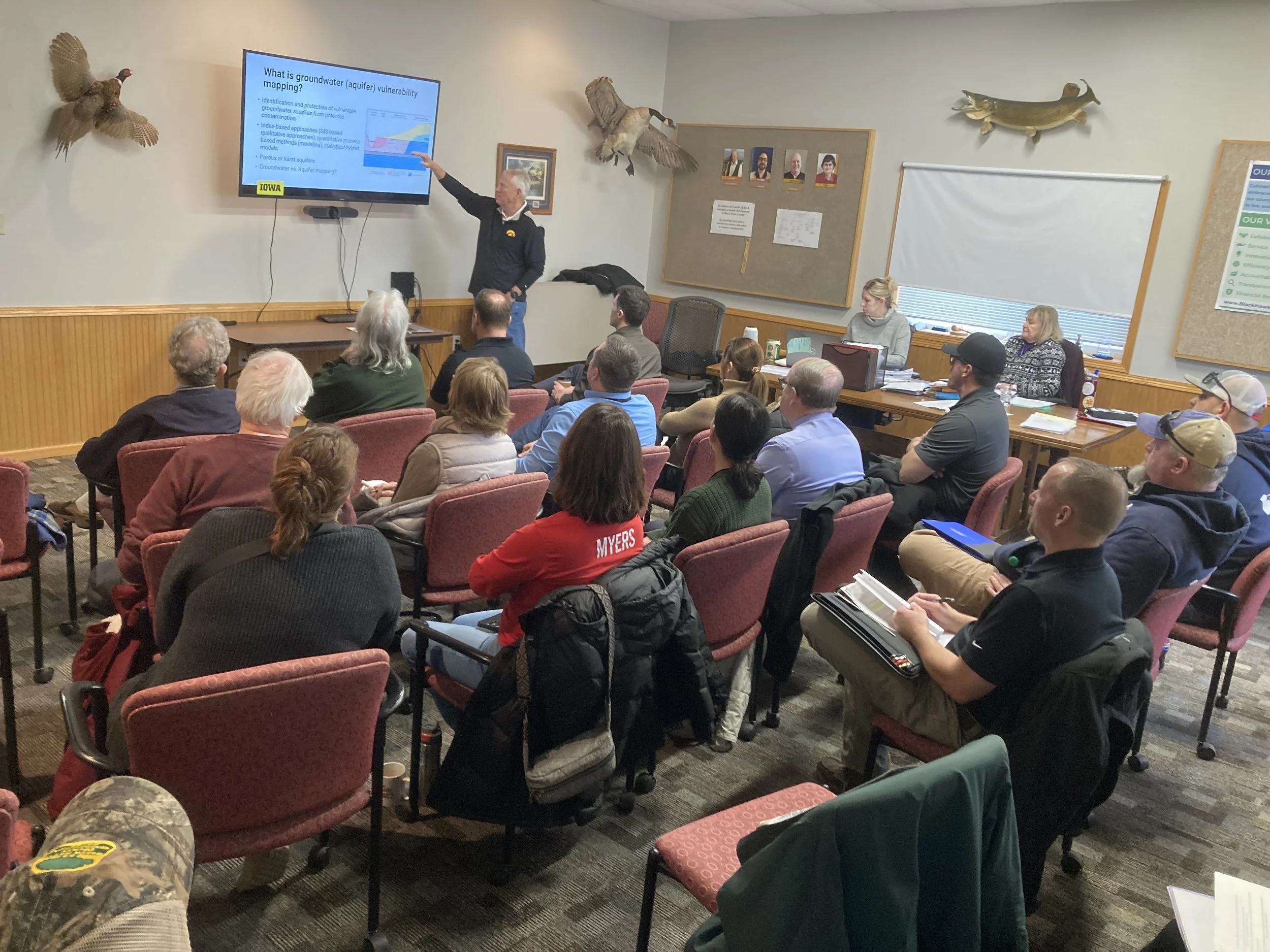
Iowa State Geologist Keith Schilling explains to Black Hawk County officials the areas of groundwater vulnerability to pollutants. Photo by the author.
We also need to be clear-eyed about our challenging situation. At this point, the current federal EPA has made it clear they will not lower 10 mg/L regulation, and the same goes for the state of Iowa. Our communities are learning about this dangerous inaction, but also that the state could set their own lower limits. We need to demand it of them. Here in Cedar Falls, we want our city council to self-impose a lower limit to protect our community.
We can make positive changes in our local communities if we take the time and actively participate. Democracy takes practice. It is not something we have, it is something we make every day.
Kamyar Enshayan is an agricultural engineer and served on the Cedar Falls City Council 2003-2011. He can be reached at kenshayan@gmail.com