

Water Scarcity, Human Migration, and a Turn Toward Fascism
by Peter Montague, SEHN fellow
Since 1750, the temperature over land, worldwide, has risen at least 2.3 degrees Celsius (°C), which equals a rise of 4.1 degrees Fahrenheit (°F). With a 2.3°C rise, the air over land can hold about 16 percent more moisture, making some rainstorms more intense, causing more floods, more runoff, more soil erosion.
As the average temperature rises, heat waves grow more extreme—hotter, longer-lasting, and more dangerous compared to two or three decades ago. For example, in the summer of 2025, heat waves killed an estimated 24,200 people in Europe.
During heat waves, the soil grows warmer and therefore drier than it used to be; at the same time, plants draw more water out of the soil—a double whammy causing more intense and longer droughts covering larger areas.
As the air warms, more mountain snowfall turns into rain and runs off quickly, depriving crops, livestock, rivers, fish and other wildlife of the traditional slow, steady snowmelt of spring and early summer. Now glaciers are melting and disappearing worldwide, depriving many human communities of their historic supply of fresh water for drinking, domestic use, and farming. Rivers fed by snow-melt and/or glacier-melt shrink, fish disappear, animals suffer, and the land is parched.
Water is life
Water is essential for all life, and it sustains the global economy, enabling mining and manufacturing, turning energy turbines, nourishing crops and livestock. Water scarcity affects farms, firms, families, communities, and nations.
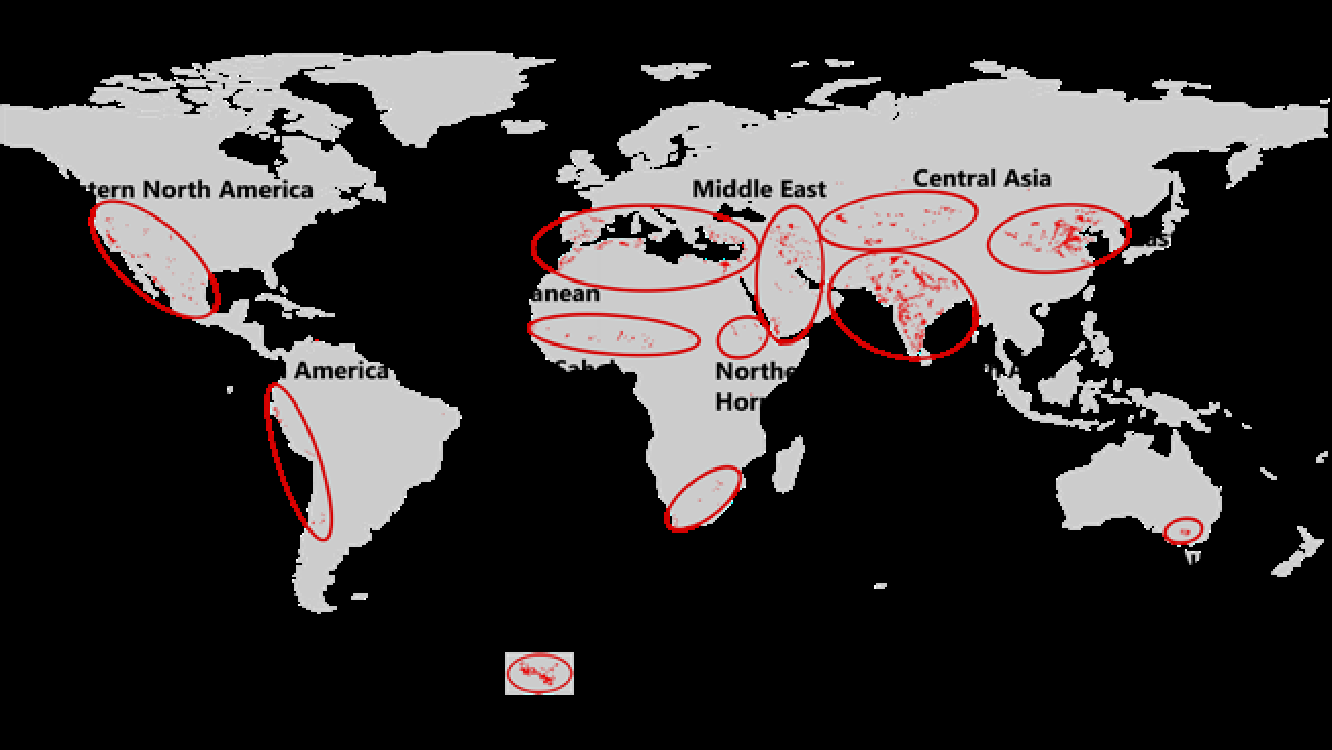
Figure 1: Global water stress hotspots. Hotspot areas are those classified by the Food and Agriculture Organization as water scarce and by World Resources Institute as areas with high, or extremely high, water stress. Source: World Meteorological Organization, 2021 State of Climate Services – Water (Geneva, Switzerland: World Meteorological Organization, 2021), pg. 8.
“We need to wake up to the looming water crisis”
In October 2021, the Secretary-General of the World Meteorological Organization (WMO) warned the world: “We need to wake up to the looming water crisis.” Since year 2000, flood-related disasters have increased by 134 percent compared to the period 1980-2000. During the same period (2000-2019), the number and duration of droughts increased 29 percent. The trend is unmistakable.
Climate change has created a permanent water problem, worldwide
Climate change has permanently disrupted the stability and predictability of the global water cycle. (Here “water cycle” means water evaporating from the surface of the ocean, drifting over land, falling to earth as rain and snow, flowing into rivers and subsurface groundwater and finally back to the ocean.) For countless generations, stability of the water cycle—meaning how much water becomes available at what time of year—has allowed farmers, foresters, families, ranchers, urban designers, industrialists, and energy planners to confidently predict water needs and availability. Now those reliable patterns no longer hold. A 2026 report from the United Nations University in Ontario, Canada, declares that the world has entered Global Water Bankruptcy.
“What we haven’t understood until now is the extent to which the fundamental stability of our political structures and global economy are predicated on relative stability and predictability of the water cycle,” says Robert Sandford of the Institute for Water, Environment and Health at McMaster University in Toronto. “As a result of these new water-climate patterns, political stability and the stability of economies in most regions of the world are now at risk,” Sandford says.
Drought: No water, no food
Drought is caused by three factors: the amount of precipitation (rain, snow), the water demand by vegetation, and the rate of evaporation from soil. Together, water demand by plants plus evaporation from soil are called “evapotranspiration.” Soil evaporation and water demand by plants are both regulated by temperature. In some cases, even when precipitation is increasing, rising temperatures can create drought from evapotranspiration, reducing water available to rivers and their users. A recent satellite study by the U.S. National Aeronautics and Space Administration (NASA) showed that, between 2003 and 2019, evapotranspiration from all the land on Earth increased 10 percent.
Wet areas of the world are growing wetter and dry areas are growing dryer, according to a NASA satellite study. “We are witnessing a huge hydrologic change,” says Jay Famiglietti of NASA’s Jet Propulsion Laboratory. “Embedded within the dry areas we see multiple hotspots resulting from groundwater depletion.”
Groundwater is water lying below the surface of the land; it feeds springs and wells. Famiglietti points out that groundwater is like money in the bank—it sustains societies through the lean times of little rain and snow. However, despite its critical importance, groundwater has attracted insufficient management attention compared to surface water in rivers and lakes. The result, he says, has been “a veritable ‘free for all’: property owners who can afford to drill wells generally have unlimited access to groundwater.” As a result, groundwater is being depleted in nearly all the world’s most productive agricultural regions, including areas of China, Australia, South America, India, the Middle East, and the United States, in the High Plains and California’s Central Valley. This is a slow-motion emergency created by naturally-occurring droughts made more frequent, more extensive, and longer-lasting by global heating.
Water scarcity leads to crop scarcity, which leads to human migration (within and across national borders) and, often, conflict. In 2020, an estimated 281 million people were living in a country other than their country of birth—128 million more than in 1990 and over three times the number in 1970. It seems unavoidable that the number of people displaced by water scarcity will continue to grow.
Migration threatens democratic rule
Increasing human migration, in turn, can threaten democratic self-rule, magnifying authoritarian and fascist tendencies. For example, for 40 percent of the population in the United States today, “the border is an existential crisis. They have heard this framing for years from every source they trust. Millions of people crossing illegally, bringing drugs, bringing crime, overwhelming hospitals and schools, changing the country they grew up in. This is the backdrop against which they evaluate everything else,” writes Christopher Armitage.
Example: MAGA
Opposing in-migration is the core idea energizing “Make America Great Again” (MAGA), a white Christian nationalist cult that now dominates the Republican party. MAGA’s Supreme Leader likes to quote Adolph Hitler, saying immigrants are “poisoning the blood of our country.” Because of our tribal response to real and imagined in-migration, the United States itself has now arrived at fascism.
To solve the global water problem and avert a global slide toward fascism, solutions would have to match the scale and scope of the problem(s).
Unfortunately, very few of the millions of well-meaning people working on climate are actually confronting the two root causes of the global water problem and the rise of fascism: (1) an economic system that requires perpetual growth (of energy-use and stuff) on a finite planet, an obvious impossibility, and (2) the trillion metric tons of carbon dioxide (CO2) that humans have added to the atmosphere since 1750.
Climate restoration
To restore the world’s water resources, we would have to restore the climate to pre-industrial conditions. Climate restoration requires eliminating carbon emissions (so-called “net-zero” emissions) but also removing the trillion metric tons of CO2 that humans have added to the atmosphere since about 1750. After “net zero” has been achieved, global temperature will remain elevated for about a thousand years, continuing to melt ice caps and glaciers, kill forests and disrupt the global water cycle, creating more floods, droughts, and crop failures.
In sum, so long as those trillion tons remain in the atmosphere, the climate, the natural world, and global water resources will continue to degrade and decline, millions more people will be forced to leave their homes to find water or food or tolerable temperatures, and fascism will find fertile ground to grow.
Perpetual growth on a finite planet: impossible
However, that is not all. Even if the climate were restored to pre-industrial conditions, economic growth would continue to butcher the natural world. Thus, an even more fundamental reform seems essential: Today’s global economic system will have to be replaced by an economic system that does not need to grow. Some call it de-growth. Advocates of de-growth argue that it can result in greater abundance and more satisfying lives than the world’s “developed” nations have yet achieved.
Before we dismiss these ideas as pie-in-the-sky, let us consider the alternative: a planet that is obviously and rapidly becoming unlivable for humans.
Faced with that stark reality, perhaps we can agree that a better world is possible if we decide to make it so.
And one thing is certain: it won’t happen if we don’t try.