
Repercussion Section: A Brief History of Typhoid Fever
by Sandra Steingraber, senior scientist and writer in residence
At a recent dinner party hosted by an architect, I was seated next to a woman who was holding forth in lively conversation. Just as the salad bowl was making its way around the table, she abruptly turned to me and asked what I did for a living.
Since I’m never sure where these kinds of conversations are headed, I typically give a short, generic description of my work to people whom I’m meeting at parties, leaving out the part about providing science to environmental justice communities fighting oil and gas extraction operations. I don’t use words like “climate change,” “carcinogens,” or “right now I’m studying the health harms of gas stoves.”
“Environmental health” was my answer over the music.
My dinner companion’s eyes lit up. “So, we do the same thing!” she said. “I’m a civil engineer. We make infrastructure. We keep human shit out of the drinking water. We stop more diseases than all the doctors.”
She leaned back and folded her arms.
Well. Challenge accepted, sister friend.
And she and I then spent the next hour—all the way through the cheese plate and chocolate—conversing about waterborne diseases from the 19th century. Many of these, we noted, are now poised for a comeback as infrastructure crumbles, vaccination rates fall, and disruptions to the global water cycle accelerate under climate change. (See Peter Montague’s essay in this same newsletter.)
It seems like the right moment for a brief history of one of them. Typhoid fever.
***
Like so many maladies named before we had a working germ theory of disease, typhoid was named for a hallmark symptom, not its cause. From a Greek word meaning smoke, “tphyii” refers to the dazed stupor that often befalls its victims.
In fact, typhoid fever is caused by a bacterium from the salmonella clan. Other members of this feared group of pathogens are responsible for many outbreaks of food poisoning. The fecal-oral route of salmonella exposure is well understood. It’s in the residue of poop on the hands of the people picking the crops or making the sandwiches.
Salmonella typhi, the typhoid bacterium, is also spread that way, but it can propagate even more rapidly by drinking water systems that are not fully isolated from sewage systems, a problem that has led to widespread epidemics in the past.
Typhoid fever may have wiped out one-third of the population of Athens in the wartime plague of 430 BC and is a leading suspect behind the recurring mass mortality events that decimated the Jamestown colony in Virginia in the early 1600s, where the hydrological cycle includes saltwater estuaries, a tidal river, spring snowmelt, and summer thunderstorms little understood by English colonists.
In the early decades of the 19th century, New York City was plagued by waterborne diseases, including typhoid fever. My dining companion was correct that engineering projects largely had solved this problem by mid-century.
First, the Croton Reservoir System was constructed between 1837-1842 to move drinking water into Manhattan from upstate watersheds in Westchester County and the Catskill Mountains via massive aqueducts. Second, a massive, closed sewer system was constructed to replace the open sewers in crowded tenement areas.
Just as critically, sanitation engineers created reliable systems for garbage pick-up, and transportation engineers created subways and a public transit system.
Thus, even before the Salmonella typhi bacterium was discovered and isolated in 1880 by a German physician (Carl Liebermeister, who also figured out how human body temperature is regulated), engineers had already won the day for disease prevention.
***
There is a sequel to the New York City typhoid story that involves another public health hero, not an engineer, who is also lost to history but who is valorized within the LGBTQ community.
Her name is Sara Josephine Baker, and she was indeed a physician. Dr. Baker was also the first director of the New York City Bureau of Child Hygiene (1907) and the first woman to earn a doctorate in public health from New York University (1917).
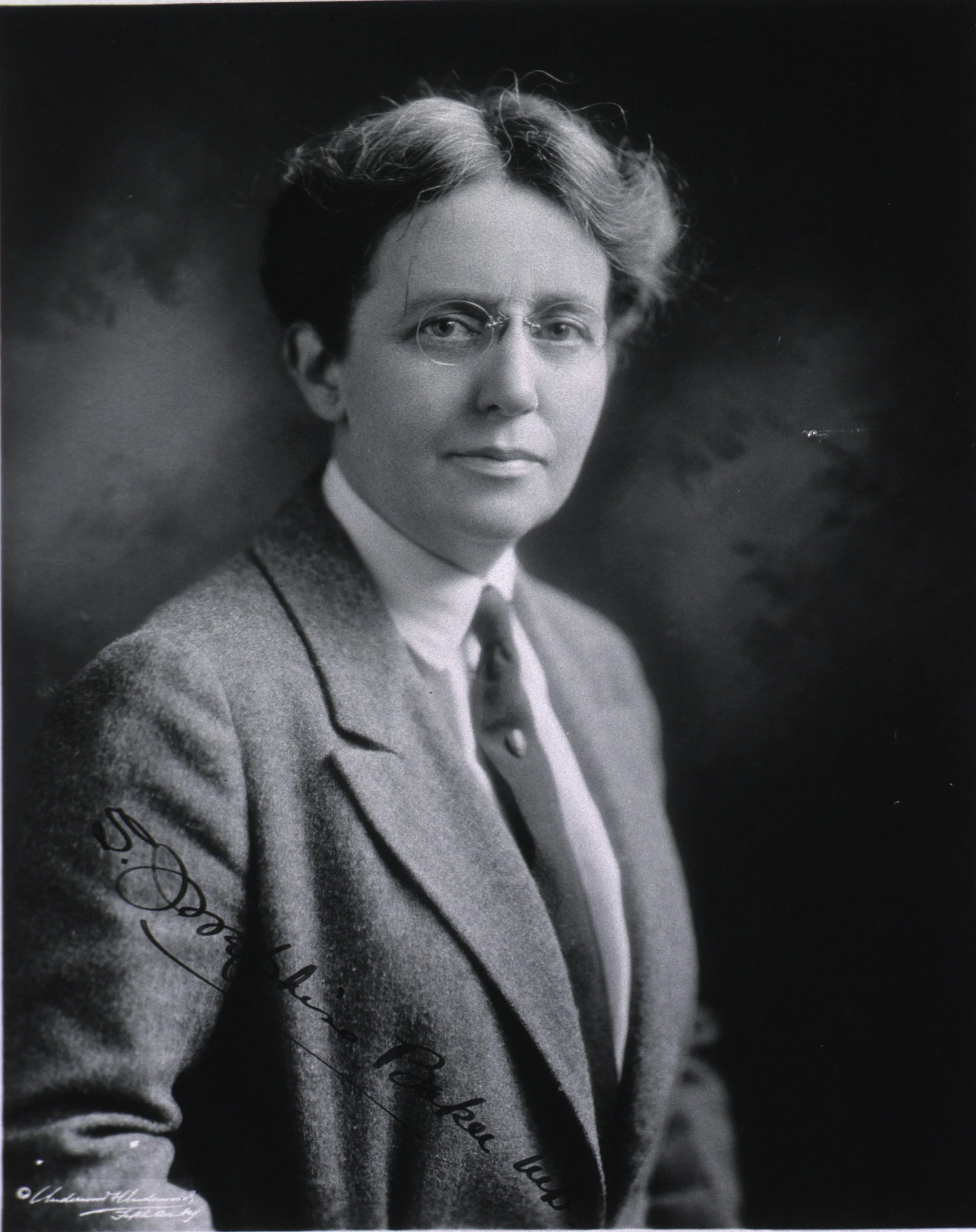
Sara Josephine Baker, MD, was the first director of the New York City Bureau of Child Hygiene. As assistant commissioner of health in 1907, she played a role in quarantining Mary Mallon, who, as a personal chef to several wealthy families, unknowingly spread typhoid fever throughout the city. By Unknown photographer - U.S. National Library of Medicine, http://resource.nlm.nih.gov/101409664, Public Domain, https://commons.wikimedia.org/w/index.php?curid=56183772
Baker lived with a woman, cross-dressed as a man, and, working as a commissioner of health, advocated for immigrant women. Working in tenement communities with newly arriving immigrants, she initiated programs for midwifery, basic sanitation, and disease prevention. Baker also founded prototypes for childcare centers in lower Manhattan and trained older siblings in the care of their younger sisters and brothers, which allowed their mothers to hold jobs while driving down infant mortality rates and the spread of contagious diseases. In Baker’s world view, practicing medicine was inextricably linked to progressive social reform, human rights, and public health education.
By the time Baker was saving the lives of women and children in New York City’s slums, the big engineering projects that brought clean water into the city—and separated it from the sewage flowing out of it—were up and running. In spite of that, in 1907, a new typhoid outbreak began ravaging the city and ultimately infected 3,000 people, of which at least ten percent died.
What was peculiar about the 1907 outbreak was that the affected households included wealthy families. The epicenters of the disease were not linked to areas of deprivation and crowding. The engineers were stumped.
By now, you probably know where this story is going. What many of these wealthy households had in common was a cook named Mary Mallon who had migrated from Ireland circa 1884.
A sanitation engineer named George Sober began stalking Mallon in an attempt to prove that she was an asymptomatic carrier. He finally cornered her and tried, unsuccessfully, to force her to provide blood and fecal samples.
Mallon reacted violently and escaped. In the cat and mouse game that followed, she variously changed her name, eluded the police, and went on cooking—her sole means of supporting herself.
Eventually, the New York Department of Health assigned Dr. Baker to apprehend Mary Mallon and bring her in for testing.
She succeeded.
But trust had already been broken. Mary was forcibly transferred to North Brother Island. After a temporary release, she returned to cooking, was recaptured, and was quarantined until her death in 1938 after she was found lying paralyzed on the floor.
Ten years later, in 1948, antibiotic treatment for typhoid fever became available.
This, of course, is the story of the woman widely villainized in the media as Typhoid Mary. Mallon was only one of 400 healthy, asymptomatic carriers of Salmonella typhi who were eventually identified by New York City health officials, but she was the only one forcibly imprisoned for three decades. She had no other family in the United States and cooking was her sole employable skill.
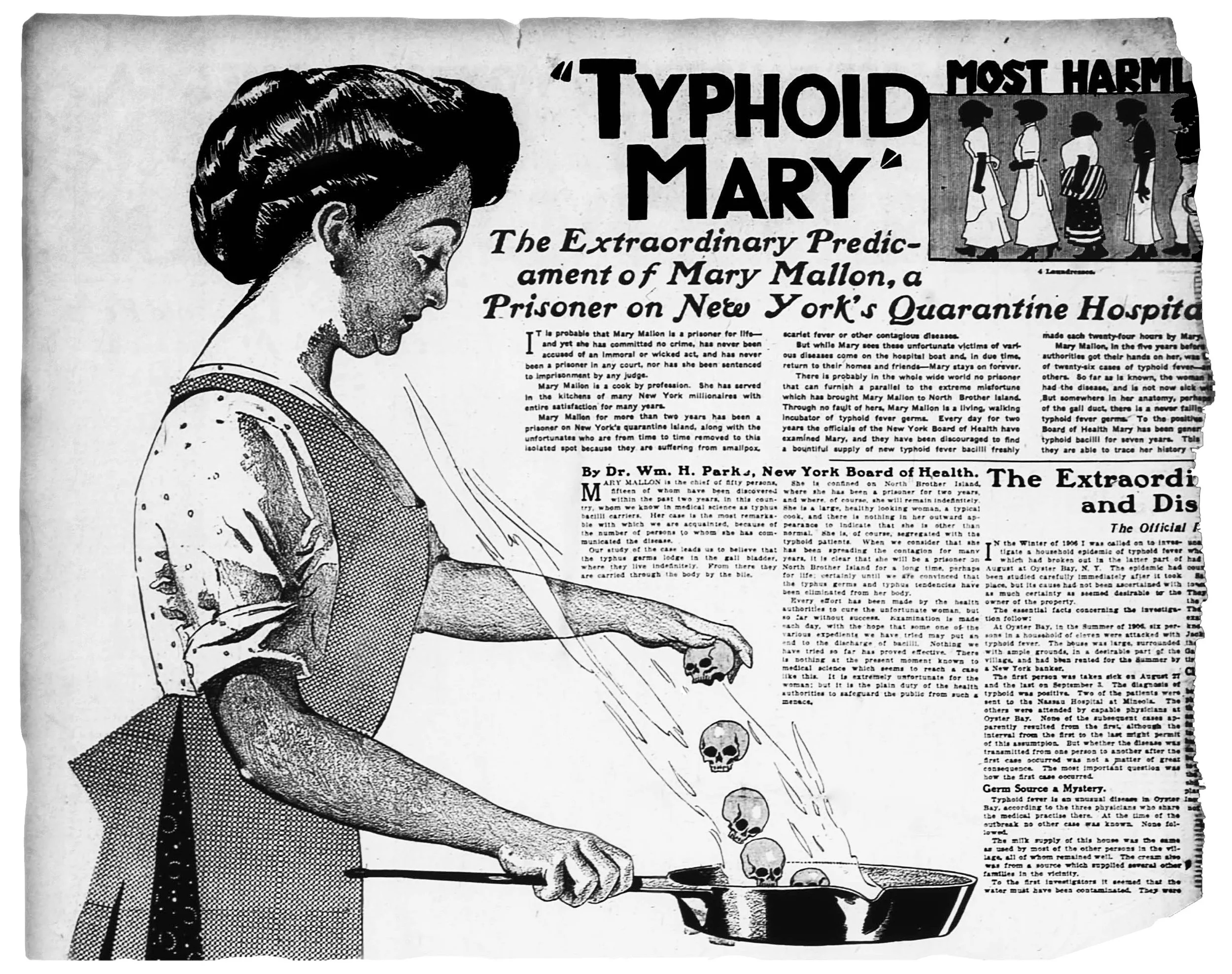
Mary Mallon (1869-1938) was demonized in the popular press as Typhoid Mary and imprisoned without due process for nearly three decades. An Irish immigrant, she was an asymptomatic carrier of the typhoid bacterium. Unknown artist, Public domain, via Wikimedia Commons, https://commons.wikimedia.org/wiki/File:Mallon-Mary_01.jpg
As an article in Annals of Gastroenterology puts it, the story of Mary Mallon, “declared unclean like a leper, may give us some moral lessons on how to protect the ill and how we can be protected from illness…the state’s pursuance and Mary’s stubbornness gave her an awkward place in the history of Medicine.”
Awkward is a funny word for thirty years of solitary confinement.
Here are the moral lessons as I see them:
Maybe men hunting down immigrant women is bad public health policy.
Maybe women health professionals like Josephine Baker—who worked in compassionate partnership with impoverished, migrant communities—should have been sent in first rather than last.
Maybe the news of resurgent typhoid outbreaks around the world, which are linked to ever-more-frequent high-intensity cyclones and flooding, should redirect our attention to the ways that the global climate crisis is simultaneously a water crisis, a disease crisis, and an engineering crisis that cries out for a precautionary approach.
In the words of the author of a new study on typhoid’s re-emergence in Fiji:
As global warming and rising ocean temperatures increase the intensity of cyclones and hurricanes for the region, we can expect to see the emergence of new Typhoid variants that could become resistant to the antibiotic therapies of choice. This resistance is widespread elsewhere in Africa and Asia. The communities in Fiji and other Pacific Islands will need to confront the infrastructure challenges that climate change will bring, including improvements to village housing, water supplies and waste management, to help limit the impact of rising sea temperatures.
Engineers and environmental health advocates, unite.