April 2026 Networker: The Cost of Forgetting Public Health |
Volume 31 (4), April 2026 |
Editor’s Note for April 2026 Networker |
I recently inherited troves of my grandparents’ documents and have been noticing how the content of these yellowing papers resonate with topics on my mind and on the minds of those in my circles; for example, infectious disease, public health, war. My grandparents had a lot of experience with the first topic, seemingly some familiarity with the second, and knew far too much of the third. They all immigrated in the early part of the 20th century and the subsequent years would provide sufficient evidence to suggest that staying back would have meant further persecution and likely death. I can’t speak for them or know exactly how they felt about life in the United States and their part in it as eventual citizens. But I am going to take a leap and say that the continued existence of the documents, how carefully they were stored and passed along, means something about how my grandparents valued what these papers signified. Aside from items like their citizenship papers, World War II ration books (all four in the series), and Social Security cards, I found the final vaccination record booklets of one set of my grandparents: “INTERNATIONAL CERTIFCATES OF VACCINATION AS APPROVED BY THE WORLD HEALTH ORGANIZATION,” issued by the “U.S. DEPARTMENT OF HEALTH, EDUCATION, AND WELFARE, PUBLIC HEALTH SERVICE.” |
WHO began planning efforts to eradicate smallpox in 1959, but the campaign fell short due to a lack of resources, funding, and global commitment. In 1967, efforts were revived through the Intensified Eradication Program. Vaccine research developments, advances in surveillance, and mass vaccination programs across the globe contributed to the success of the program. |
Somehow—and again, I don’t have the words of my grandparents to prove it—I can’t imagine them resisting or hesitating to take part in such an initiative. Putting an end to a legacy of three hundred million deaths in the 20th century alone, as well as countless cases of blindness and disfigurement, seems like a campaign they would have been more than willing to take part in. A later page in the booklet is for cholera, an acute diarrheal infection caused by consuming food or water contaminated with the bacterium Vibrio cholerae, still common today in places without basic sanitation and safe water supplies. Rare in the United States, Canada, and Mexico, Americans typically only pursue the cholera vaccine when planning travel to parts of the world where it is rampant. Basic public health measures have spared (for now?) our continent this affliction. My grandparents though, had a collective memory of the cholera epidemics in Eastern Europe in the 19th century that killed millions. My paternal grandmother was inclined to use the Yiddish phrase “ah chaleria!” (a cholera!) to react to the mention of a catastrophe or really, any sorry situation. If we need any more evidence of how interconnected our current global crises are, this article appeared in one of my news feeds recently: “Cholera aid for African countries stalled by Iran conflict.” Due to the war on Iran, emergency cholera supplies are reported to be stranded in Dubai warehouses just as the rainy months are set to begin, when risk worsens. Some of the supplies are intended for Chad, which hosts many Sudanese who have fled war. My maternal grandmother’s immigration journey involved the care of nephews and a niece whose mother had recently died in the so-called Spanish Flu epidemic of 1918-1920. That influenza epidemic was made as severe as it was by conditions related to military activity at the time, the First World War and its aftermath. (All my relatives of that generation spoke about various waves of passing-through soldiers quartered in their houses.) As with the emergency cholera aid stuck in Dubai today, war impacts infectious disease transmission and control in countless ways. Two of those migrating children suffered with the measles en route to the United States. In addition to obvious fears about their surviving the disease (and one of the migrating aunts also feared they’d be thrown overboard), their illnesses led to delays in their entry processing and a one-week separation of the family at the port in Philadelphia. After that harrowing experience, I can presume the family embraced the widespread measles immunization efforts in place by the late 1960s. What would they make of the newest data on the numbers of unvaccinated children, and 2026 headlines such as, “US nears 1,700 measles cases, with 73 new infections in Utah”? |
The United States is on pace to top last year’s measles total this spring. The country will likely lose its measles elimination status—which it gained in 2000—in November, when officials assess the data. |
Many of us feel as a nation we’re going backwards (at best). We search daily for the most effective personal and collective responses and act on them, while we don’t lose sight of what a federal government’s sound public health-protective policy should look like. In this edition of the Networker, we’re so pleased to describe and link to a remarkable set of papers reflecting a 20+ year effort toward those kinds of policies. SEHN’s Ted Schettler, involved from the beginning in developing parts of the Louisville Charter for Safer Chemicals, recently completed the revision of one of its ten planks. Carolyn Raffensperger writes about public health as neighborliness, and Sandra Steingraber's column explores the historical role of the scientist as public health messenger. As individuals we obviously can’t make up for the decimation of what many of us may have taken for granted as basic functions of the federal government (though we can be loud as advocates and voters, as well as focus on state and local level policies), let alone for the colossal harm our government is inflicting elsewhere via a war of choice and other acts of violence. But a reinvigorated individual commitment to collective societal responsibility (a most expansive neighborliness, or we might say solidarity) for the health, safety, and rights of others can surely help to get us back on track, and protect the vulnerable while we do. |
As my grandparents all would say in parting, geyt gezunterheyt (go in good health),
Carmi Orenstein, MPH
|
One Bridge to Collective Health: Neighborlinessby Carolyn Raffensperger, executive director |
Consider the possibility that the bridge between your individual health and public health is neighborliness. By neighborliness I mean treating members of your community with care. Literally, “doing unto others as we would have done to ourselves.” I’ve been thinking about neighborliness and what it entails ever since watching Minneapolis carry out the care of their neighbors with exquisite, dedicated compassion during the immigration raids. Need food? A Ride? Babysit kids? It was done, on a large scale and over a comparatively long time. It seems that Minneapolis has lessons for us about public health, because wasn’t that what they were practicing? True public health with every act of care. People who were hungry or scared had someone, often a stranger, step in to alleviate their suffering. SEHN has worked at the nexus of medicine and public health since its inception in 1994, drawing the connections between toxic chemicals and rising trends of ill health including birth defects, cancer, and asthma. It is hard to prove that any single cancer is caused by an exposure to a carcinogen, but epidemiologists can begin to pin down cause and effect by looking at patterns of disease in populations, communities, and yes, neighborhoods. We are dependent on a large web of life to sustain us. Our health depends on our animal (human and otherwise), vegetable and mineral neighbors. Wendell Berry said that “health is membership.” As members of a community, we have responsibilities to other members, and they to us. These responsibilities flow from the precept that we have rights with each other as much as we have rights to things like free speech. Actually, the right to a clean and healthy environment as recognized by the United Nations and several states in the U.S. cannot be fulfilled in isolation, cut off from each other and the natural world.
Continue Reading |
The Louisville Charter for Safer Chemicals: Newly Available Policy Papers and SEHN’s Longtime Participation |
In May 2004, organizers in Louisville, Kentucky convened a broad coalition of grassroots, labor, health, and environmental justice groups whose common goal was to promote government policies that protect human health and the environment from exposure to unnecessary harmful chemicals. This initiated a year-long collaborative process to create the original Louisville Charter For Safer Chemicals, which served as a shared platform for change. In the ensuing years, the original Louisville Charter has undergone revisions to more explicitly confront the chemical industry's massive contribution to the climate crisis and provide principled guidance for advancing environmental justice in communities disproportionately impacted by harmful and cumulative chemical exposure, while avoiding false solutions. The Policy Papers that comprise the Louisville Charter are available here. The most recent revisions are papers #4, Use Scientific Data to Support Health-Protective Policies and Practices and #6, Act with Foresight to Protect Health and Prevent Pollution. Continue Reading |
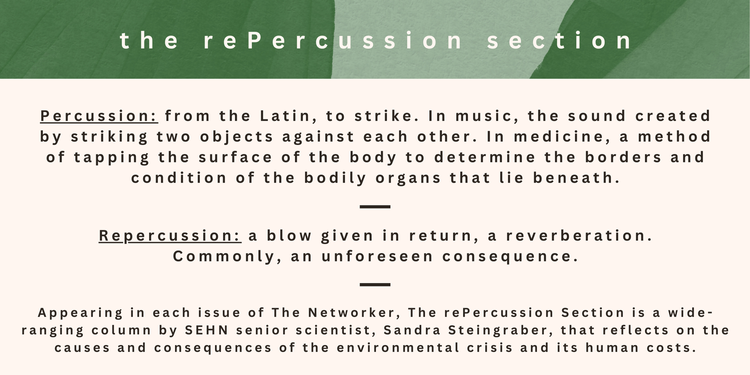
Repercussion Section: Scientist as Messenger, a Brief Historyby Sandra Steingraber, senior scientist and writer in residence |
The undisputed OG of science communications in the United States is biologist Rachel Carson. Her 1962 book Silent Spring, a critique of 19 commonly used pesticides, spoke far beyond its immediate subject matter. Written in lyrical, imagistic prose and backed by 50+ pages of peer-reviewed citations, Silent Spring awakened public consciousness about the interconnections of human beings and their environment and profoundly shifted how Americans thought about the determinants of health. No other science book since, maybe, Origin of Species, comes close to serving as a founding force for a new understanding of our species’ place in the natural world. Winning all the writing awards and rocketing to the top of the bestseller lists, Silent Spring provoked Congressional hearings, prompted an invitation to the author to meet with the President’s science advisors, and led to the establishment of the U.S. Environmental Protection Agency. In the ten years between 1963 and 1973, the book also inspired at least five major pieces of federal legislation (The Clean Air Act, the Wilderness Act, the National Environmental Policy Act, the Clean Water Act, and the Endangered Species Act) in spite of the fact that Rachel Carson had already died of breast cancer. Silent Spring, also, of course, triggered a massive backlash from the chemical industry.
Continue Reading |
|
|